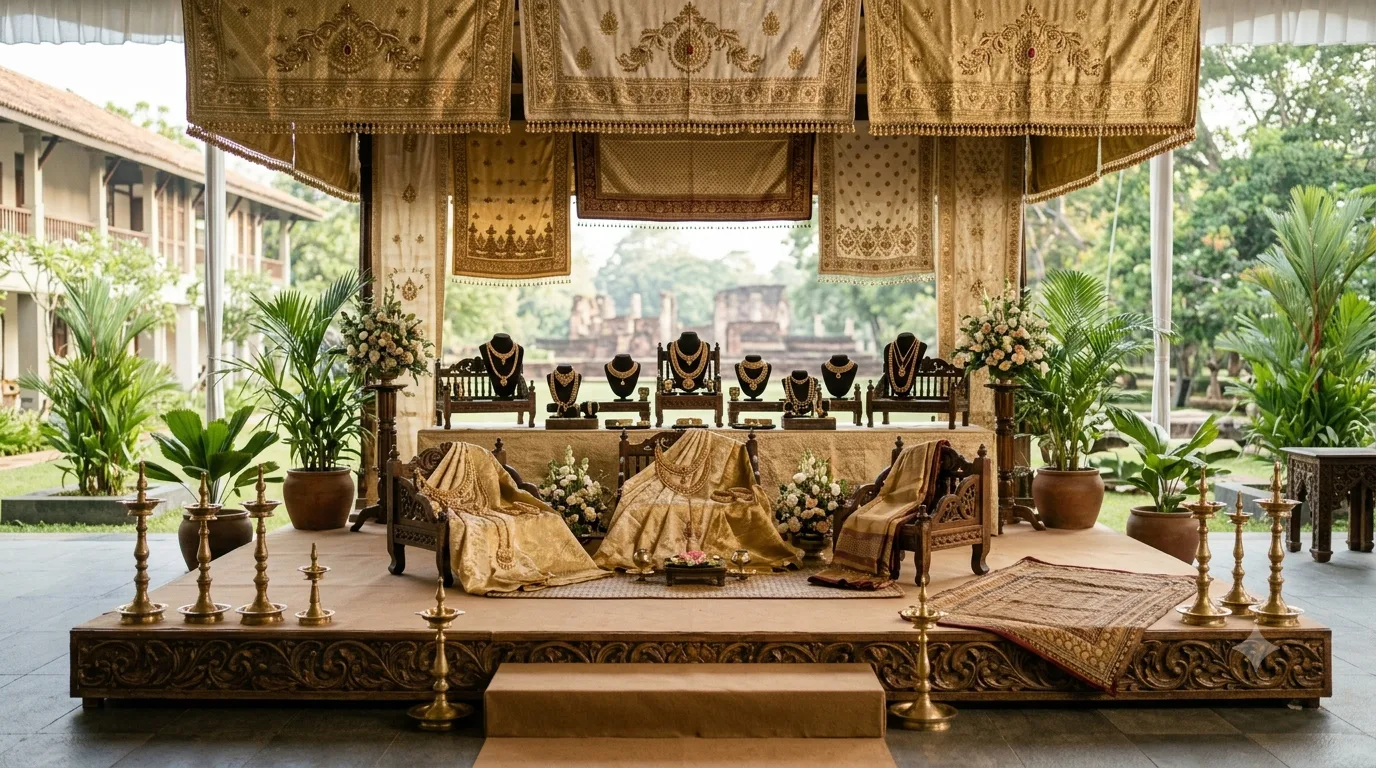
In Sri Lanka, a wedding can look like a million-dollar production—and almost every piece of it will be handed back the next morning.
Of every category examined in Sri Lankan rental culture, none is as commercially mature, as culturally sanctioned, or as economically load-bearing as the wedding and banquet industry. Unlike renting a car or an apartment — decisions that can still carry a whiff of "couldn't afford to buy" — renting for a wedding is not a compromise in Sri Lanka. It is, and largely always has been, the default operating model. Almost nobody buys a poruwa. Almost nobody owns 300 chairs. The entire architecture of a Sri Lankan wedding is built on temporary access to expensive things, stitched together for a single day.
The issue is not just the magnitude of the cost, but also the fact that for a couple still finding their financial footing in this harsh economy, a wedding would become no more than a dream, a fantasy, if not for the renting culture that exists in today's society.
What a Sri Lankan Wedding Actually Costs
The cost of a wedding may vary significantly based on scale and luxury, but based on the common consumer patterns we can build a moderate estimation of how things are progressing.
Venue and Catering:
Sri Lankan hotel wedding packages typically price catering in the range of roughly Rs. 15,000 to 20, 000 per head. Thus a moderate 150-guest hotel wedding could cost around 2-3 million for food and venue alone.
Poruwa ceremony essentials:
The ceremonial platform, traditional dancers, drummers, and the officiant/kapuwa, run around Rs. 80,000 as a package rate at hotel-run weddings — and this is almost always hired, never owned, since a poruwa has no use outside a wedding day.
Community/ religious weddings:
Non-hotel run weddings may run a slightly leaner but still substantial cost. A detailed local breakdown of a Muslim wedding may put the venue hire alone between 500k to a million, depending on various factors pertaining to the venue. And the food cost per sahan (a unit that would serve 5-6 people) would be around Rs.5000, thus a 250 guest wedding could need about 50 sahans raising the food cost alone to Rs. 250k.
This combined with other costs such as attire, mahar and much more would push the price significantly higher.
Thus even conservative estimates put a modest local Sri Lankan wedding at Rs. 1–3 million, a genuinely large sum against a national average monthly salary meaning a single wedding day can cost more than a year and a half of an average earner's take-home pay.
The Rental Mechanics: What Actually Gets Hired, and How
The wedding rental economy in Sri Lanka operates through several distinct, overlapping mechanisms:
Full-service venue-and-decor bundling: Hotels and dedicated banquet halls sell wedding "packages" that bundle venue hire, furniture, linens, basic decor, and catering into a single per-head or flat rate. This is the most consolidated form of rental — the couple never individually sources a single chair.
Independent equipment and decor rental firms: For couples who don't want a hotel package — home weddings, garden weddings, community-hall weddings — a dense layer of independent rental businesses fills the gap. Companies supply everything from LED screens and sound systems to lighting for weddings, corporate events, and productions. Décor-specific firms rent chair covers, backdrops, centerpieces, and table settings letting couples assemble a custom look without owning any of it. But if you looking to browse all of these on a single platform, LATELY has got you covered. A premiums platform that will cover any and all your needs
Attire rental — the most normalized rental category of all: Groom's suits and tuxedos have been rented as a matter of course for decades — renting a wedding suit is widely considered the financially sensible choice for grooms in Sri Lanka, delivering a polished look without the expense of a one-time purchase. Bridal and occasion sarees follow the same logic. All of which you can find by your very trusted renters on LATELY.
Jewelry and accessory hire: Traditional Kandyan bridal jewelry — the elaborate necklace sets, headpieces, and ornaments worn for the poruwa ceremony — is overwhelmingly rented rather than bought, since a full set can cost more than most families could justify for a single-day use.
Entertainment and ritual labor as a rental category: This is a distinctly Sri Lankan wrinkle: much of what's "rented" for a wedding isn't an object at all but a service package — traditional Kandyan dancers, drummers, the kapuwa (ritual officiant), and the "jayamangala gatha" chanters are booked for the day exactly like equipment, priced per event rather than employed. In effect, the entire ceremonial apparatus of a traditional wedding — costume, music, ritual expertise — is accessed on a pay-per-use basis, not owned or retained.
Why Renting Is the Financially Rational Choice for Young Couples
This is where the wedding rental economy becomes more than a matter of convenience — it's a genuine affordability mechanism for couples still building financial stability.
Sri Lanka's wedding industry is, in effect, a fully realized "access economy" that predates the term by generations — where poruwas, ceremonial jewelry, formal attire, décor, sound systems, and even ritual expertise are treated as services to be accessed for a day rather than assets to be owned for life. What's changed is not the mechanism but its framing: renting for a wedding has moved from being simply "how it's done" to being actively promoted as a deliberate financial strategy for a generation of couples marrying later, more cautiously, and with considerably less certainty about the economy than their parents had. In a market where the average wedding can swallow more than a year's take-home pay, the rental economy isn't peripheral to how Sri Lankans marry. It's the thing that makes marrying, for many young couples, still possible.